
 Get Well Natural, LLC
  Kidney Function & Regeneration Health
  Platelet & Blood Cell Health
  Prostate, Flow & Function Health
  General Mind & Body Health
  Heart, Cholesterol & Cardio Health
  Allergy-Free Body
  Anxiety & Stress
  Blood Platelet Counts & Function
  Blood Pressure Health
  Kidney Health
  Immune System Health & Balance
  Prostate & Urinary Health Function
  Blood Sugar Balance
  Cardiovascular Heart Health
  Detoxification & Healthy Cells
  Women's Health
  Liver Regeneration
  Pain-Free Body
  Water & Air Filtration


Featured Health Support Products
ITP Kit
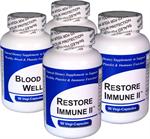
The all herbal formulas in the ITP Kit are developed by Doctors based on their understanding of how to naturally support:
- Healthy Normal Platelet Counts & Quality*
- Healthy Blood Coagulation Function*
- Promoting Normal Healing from Bruising, Petechiae or Bleeding*
Contains one month supply of:
Blood Well (180 Vegi-Capsules)
Restore Immune II (180 Vegi-Capsules)
For the ITP Kit: 
100% Money Back Guarantee!
What is I.T.P.?
I.T.P. (Idiopathic Thrombocytopenic Purpura), also known as Immune Thrombocytopenic Purpura, is classified as an autoimmune disease with symptoms of low platelets and with no known cause (idiopathic, according to western medicine).
Read About Platelet Function Health...*
What are the Symptoms of I.T.P.?
A person with too few platelets bruises easily, can bleed for a long period of time after being injured and may also have nosebleeds that are hard to stop. Bruising may also take longer to heal. Petechiae is another symptoms of I.T.P. and comes in the form of tiny red dots on the skin.
The average healthy person has 150,000 to 300,000 platelets in each milliliter of blood. For those with I.T.P, platelet counts can often drop to levels as low as 1,000-20,000 platelets/L. Each year, there are 50-100 new cases of I.T.P. per million people and children account for half of that amount.
In people with I.T.P. the blood cells are normal except for the blood platelets. Platelets are tiny blood cells with irregularly-shapes that are produced in the bone marrow and whose main function is to control bleeding and form clots from cuts and wounds. Platelets take part in the blood clotting process (coagulation).
[Top]
What is Autoimmune I.T.P.?
In an autoimmune disease the body mounts an attack toward one or more otherwise normal organ systems. In I.T.P., platelets are the target. People with I.T.P. form antibodies that can destroy their platelets. In healthy individuals, antibodies are a healthy response to toxins like bacteria or viruses. For those with I.T.P., however, the antibodies attack the body's own blood platelets and are destroyed and recycled in the spleen.
An adequate number of normally functioning platelets is needed for people with I.T.P. to prevent leakage of red blood cells from apparently uninjured vessels as well to prevent a hemorrhage. Extra care and support is needed for those experiencing I.T.P. types of symptoms.
[Top]
More Information on Idiopathic Thrombocytopenic Purpura
Idiopathic thrombocytopenic purpura (I.T.P.) is a bleeding condition in which the blood doesn't clot as it should. This is due to a low number of blood cell fragments called platelets (PLATE-lets).
Platelets also are called thrombocytes (THROM-bo-sites). They're made in your bone marrow along with other kinds of blood cells. Platelets stick together (clot) to seal small cuts or breaks on blood vessel walls and stop bleeding.
"Idiopathic" (id-ee-o-PATH-ick) means that the cause of the condition isn't known. "Thrombocytopenic" (throm-bo-cy-toe-PEE-nick) means there's a lower than normal number of platelets in the blood. "Purpura" (PURR-purr-ah) refers to purple bruises caused by bleeding under the skin.
[Top]
I.T.P. Overview
People who have I.T.P. often have purple bruises that appear on the skin or on the mucous membranes (for example, in the mouth). The bruises mean that bleeding has occurred in small blood vessels under the skin.
A person who has I.T.P. also may have bleeding that results in tiny red or purple dots on the skin. These pinpoint-sized dots are called Petechiae (peh-TEE-kee-ay). Petechiae may look like a rash.
[Top]
Petechiae and Purpura
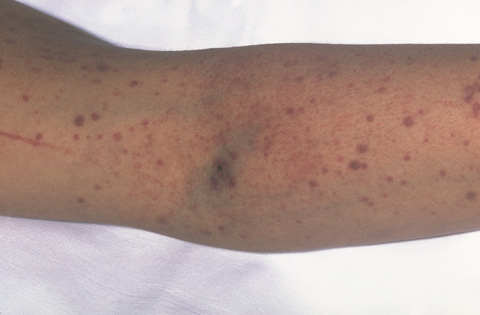
The photograph shows Petechiae (red/purple dots) and purpura (bruises) in the skin. Bleeding under the skin causes the purple, brown, and red color of the petechiae and purpura.
People who have I.T.P. also may have nosebleeds, bleeding from the gums when they have dental work done, or other bleeding that's hard to stop. Women who have I.T.P. may have menstrual bleeding that's heavier than usual.
More extensive bleeding can cause hematomas (he-mah-TO-mas). A hematoma is a collection of clotted or partially clotted blood under the skin. It looks or feels like a lump.
Bleeding in the brain as a result of I.T.P. is very rare, but can be life threatening if it occurs.
In most cases, an autoimmune response is believed to cause I.T.P.. Normally your immune system helps your body fight off infections and diseases. But if you have I.T.P., your immune system attacks and destroys its own platelets. The reason why this happens isnt known.
I.T.P. can't be passed from one person to another.
[Top]
Types of Idiopathic Thrombocytopenic Purpura
There are two types of I.T.P.: acute (temporary or short-term) and chronic (long-lasting).
Acute I.T.P. generally lasts less than 6 months. It mainly occurs in children, both boys and girls, and is the most common type of I.T.P.. Acute I.T.P. often occurs after an infection caused by a virus.
Chronic I.T.P. is long-lasting (6 months or longer) and mostly affects adults. However, some teenagers and children can get this type of I.T.P.. Chronic I.T.P. affects women 2 to 3 times more often than men.
Treatment depends on how severe the bleeding symptoms are and the platelet count. In mild cases, treatment may not be needed.
[Top]
I.T.P. Prognosis & Outlook
For most children and adults, I.T.P. isn't a serious or life-threatening condition.
Acute I.T.P. in children often goes away on its own within a few weeks or months and doesn't return. In 80 percent of children who have I.T.P., the platelet count returns to normal within 6 to 12 months. Treatment may not be needed.
A small number of children, about 5 percent, whose I.T.P. doesn't go away on its own may need to have further medical or surgical treatment.
Chronic I.T.P. will vary with each individual and can last for many years. Even people who have severe forms of chronic I.T.P. can live for decades. Most people who have chronic I.T.P. are able at some point to stop treatment and keep a safe platelet count.
Revised June 2009
Source http://www.nhlbi.nih.gov/health/dci/Diseases/Itp/ITP_WhatIs.html
More from the NIH http://www.nlm.nih.gov/medlineplus/ency/article/000535.htm
Idiopathic thrombocytopenic purpura (I.T.P.)
Idiopathic thrombocytopenic purpura is a bleeding disorder in which the immune system destroys platelets, which are necessary for normal blood clotting. Persons with the disease have too few platelets in the blood.
ITP is sometimes called immune thrombocytopenic purpura.
Causes
ITP occurs when certain immune system cells produce antibodies against platelets. Platelets help your blood clot by clumping together to plug small holes in damaged blood vessels.
The antibodies attach to the platelets. The spleen destroys the platelets that carry the antibodies.
In children, the disease sometimes follows a viral infection. In adults, it is more often a chronic (long-term) disease and can occur after a viral infection, with use of certain drugs, during pregnancy, or as part of an immune disorder.
ITP affects women more frequently than men, and is more common in children than adults. The disease affects boys and girls equally.
Symptoms
- Abnormally heavy menstruation
- Bleeding into the skin causes a characteristic skin rash that looks like pinpoint red spots (petechial rash)
- Easy bruising
- Nosebleed or bleeding in the mouth
Exams and Tests
Laboratory tests will be done to see how well your blood clots and to check your platelet count.
- A complete blood count (CBC) shows a low number of platelets.
- Blood clotting tests (PTT and PT) are normal.
- Bleeding time is prolonged.
- Platelet associated antibodies may be detected.
A bone marrow aspiration or biopsy appears normal or may show a greater than normal number of cells called megakaryocytes. These cells are an early form of platelets.
Treatment
In children, the disease usually goes away without treatment. Some children, however, may need treatment.
Adults are usually started on an anti-inflammatory steroid medicine called prednisone. In some cases, surgery to remove the spleen (splenectomy) is recommended. This will increase the platelet count in about half of all patients. However, other drug treatments are usually recommended instead.
Splenectomy
Spleen Removal - NIH http://www.nlm.nih.gov/medlineplus/ency/article/002944.htm
Spleen removal (splenectomy) is surgery to remove a diseased or damaged spleen. This organ is in the upper part of your belly, on the left side underneath the rib cage.
The spleen helps your body fight germs and infections. It also helps filter your blood.
Back to NIH
If the disease does not get better with prednisone, other treatments may include:
- A medicine called danazol (Danocrine) taken by mouth
- Injections of high-dose gamma globulin (an immune factor)
- Drugs that suppress the immune system
- Filtering antibodies out of the blood stream
- Anti-RhD therapy for people with certain blood types
People with ITP should not take aspirin, ibuprofen, or warfarin because these drugs interfere with platelet function or blood clotting, and bleeding may occur.
Outlook (Prognosis)
With treatment, the chance of remission (a symptom-free period) is good. Rarely, ITP may become a long-term condition in adults and reappear, even after a symptom-free period.
Possible Complications
Sudden and severe loss of blood from the digestive tract may occur. Bleeding into the brain may also occur.
When to Contact a Medical Professional
Go to the emergency room or call the local emergency number (such as 911) if severe bleeding occurs, or if other new symptoms develop.
Prevention
The causes and risk factors are unknown, except in children when it may be related to a viral infection. Prevention methods are unknown.
Alternative Names
Immune thrombocytopenic purpura; ITP
References
McMillan R. Hemorrhagic disorders: abnormalities of platelet and vascular function. In: Goldman L, Ausiello D, eds. Cecil Medicine. 23rd ed. Philadelphia, Pa: Saunders Elsevier; 2007:chap 179.
Update Date: 3/28/2010
Updated by: David C. Dugdale, III, MD, Professor of Medicine, Division of General Medicine, Department of Medicine, University of Washington School of Medicine; James R. Mason, MD, Oncologist, Director, Blood and Marrow Transplantation Program and Stem Cell Processing Lab, Scripps Clinic, Torrey Pines, California. Also reviewed by David Zieve, MD, MHA, Medical Director, A.D.A.M., Inc.
Read About Platelet Function Health*
[Top]